
Get ready for a celestial spectacle as a rare planetary alignment graces the Philippine skies from February 21 to 28, 2025. Dubbed the "planet parade," this cosmic event, according to the Philippine Atmospheric, Geophysical and Astronomical Services Administration (PAGASA), will feature Mercury, Venus, Mars, Jupiter, Saturn, Uranus, and Neptune appearing in a near-straight line—a mesmerizing sight for both astronomy buffs and casual stargazers alike.
What Exactly is a Planet Parade?
A planetary alignment occurs when multiple planets position themselves along the same general region of the sky, forming a striking visual alignment. While these events are not perfectly linear due to each planet’s unique orbit, this particular arrangement offers a rare chance to see seven planets at once—a phenomenon that won’t happen again anytime soon.
The last time a similar alignment occurred was in July 2022, and another one is expected in August 2025, though that event will feature only six planets—Mercury, Venus, Jupiter, Saturn, Uranus, and Neptune.
The Best Time to Spot the Planets from the Philippines
The best time to observe this cosmic event is just after sunset, around 6:30 p.m. Philippine Standard Time, when the planets will begin to appear in the evening sky.
Venus will be the first to shine, easily recognizable due to its intense brightness near the horizon. Jupiter, one of the most luminous objects in the night sky, will be visible higher up shortly after. As the sky darkens, Mars will make its appearance with a distinct reddish glow, while Saturn can be spotted in the southwestern sky—though an unobstructed view of the horizon may be necessary to see it clearly. Mercury, being closer to the Sun, may be more difficult to spot without the aid of binoculars. Lastly, Uranus and Neptune, which are the most distant of the group, will require a telescope to be seen properly, but those who make the effort will be rewarded with a rare glimpse of these outer planets.
Where to Watch the Planet Parade in the Philippines
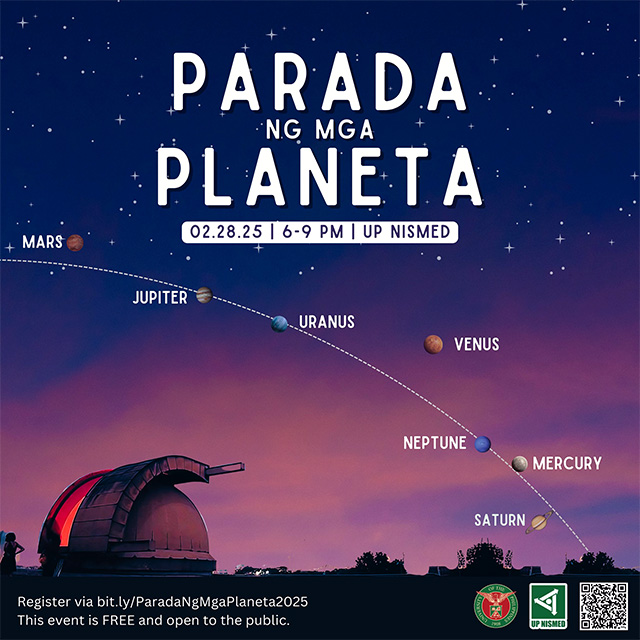
For those who want a guided viewing experience, two observatories in Metro Manila are welcoming the public:
-
UP NISMED Observatory (University of the Philippines - National Institute for Science and Mathematics Education Development) is hosting a special event called "Parada ng mga Planeta" on February 28, from 6-9 p.m. Entrance is free.
-
PAGASA Observatory is open daily from 6 p.m. for small groups, with a P25 per person admission fee.
Hey, Preview readers! Follow us on Facebook, Instagram, YouTube, Tiktok, and Twitter to stay up to speed on all things trendy and creative. We’ll curate the most stylish feed for you!
