
The "First Philippine Polymer Banknote Series" from Bangko Sentral ng Pilipinas (BSP) was officially unveiled during a ceremony in Malacañang on Wednesday, December 19, 2024.
What immediately caught the public's attention was that—unlike the old paper bills that featured Filipino heroes and notable figures like Diosdado P. Macapagal, Andres Bonifacio, and Benigno Aquino Jr., the polymer banknotes under the administration of President Ferdinand R. Marcos Jr. bear endangered Philippine flora and fauna as well as the country's natural wonders. There's also the fact that this new series is made from polymer material, which was first used in the 1000-piso banknote introduced in April 2022.
This significant departure from tradition not only reflects a shift in design priorities but also introduces several unique features and details.
Everything You Need to Know About the First Philippine Polymer Banknote Series
1. Polymer Banknotes Versus Paper Bills
BSP boasts that the new polymer banknotes are "smarter, cleaner, stronger."
It's supposed to have "more sophisticated security features, making it harder to counterfeit." A 2023 study published in an international, peer-reviewed, open-access journal called Sustainability explained that the optical security features of a polymer banknote make it impossible to use scanners and photocopiers to duplicate them. The transparency of the material also adds to the banknote's security label.
The Department of Health also confirmed that the smooth and non-absorptive surface, which is resistant to water, oil, and dirt, is more sanitary. Previous studies have cited that polymer-based banknotes have a relatively lower bacterial count compared with cotton-based/"paper" banknotes.
The BSP also banks on the durability of polymer banknotes, which are supposed to last two to five times longer than paper banknotes and thus lower banknote issue expenses in the long term. In addition, the use of polymer in banknotes also results in the "reduction of pollutant emissions to the environment and a decrease of the depletion of natural resources," as concluded in a 2018 study that compared the life cycle of Mexican polymer and high-durability cotton paper banknotes.
2. Design: Focus on Flora and Fauna, No Philippine Heroes and Leaders
BSP's First Philippine Polymer Banknote Series features Philippine flora and fauna in the front, reflecting our country's rich biodiversity. In the back, it has preserved elements from the paper banknotes, particularly natural wonders and artisanal crafts.
In an FAQ post by the BSP, they said that the reason behind choosing wildlife designs in the new polymer banknotes is that: "Featuring different symbols of national pride in our banknotes and coins reflect numismatic dynamism and artistry and promotes appreciation of the Filipino identity."
BSP Governor Eli M. Remolona, Jr. added in a statement: "The polymer series raises awareness of the country’s threatened species, serves as a symbol of Filipino identity, and fosters national pride."
1000-Piso: Philippine eagle and sampaguita flower (front); Tubbataha Reefs Natural Park, South Sea pearl, and the T’nalak weave design (back)
The Philippine eagle (Pithecophaga jefferyi) is considered to be one of the largest and most powerful among forest raptors. This endemic eagle has an estimated number of only 180 to 500 left in the wild, listing it as critically endangered (CE) by the International Union for Conservation of Nature (IUCN). Deforestation and illegal hunting continue to threaten this keystone species, which means that it is an ecological indicator of an ecosystem's health. As an apex predator in the Philippine forests' food chain, it also helps regulate the population of other species.
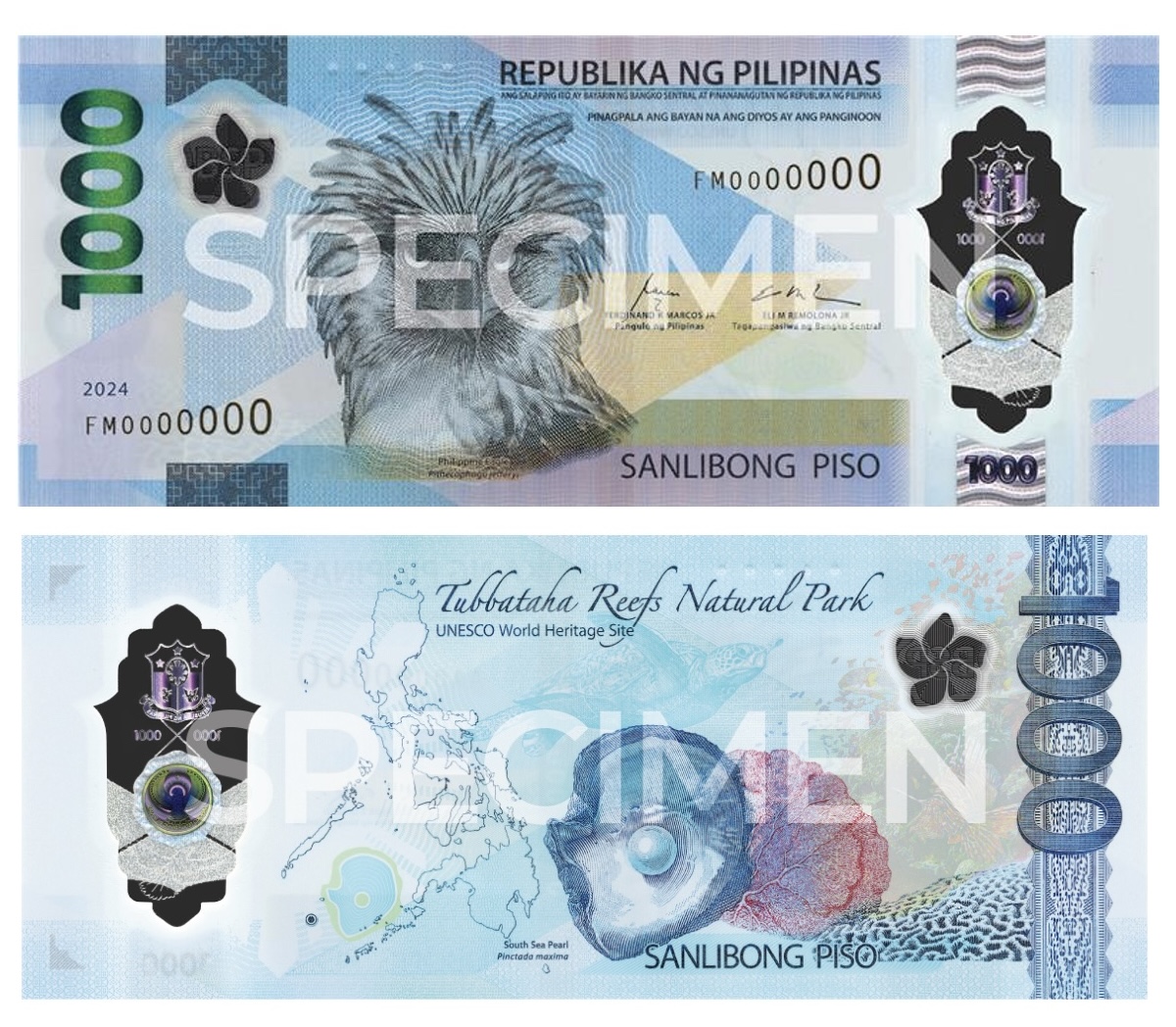
The sampaguita flower (Jasminum sambac) was declared the national flower by American Governor-General Frank Murphy in 1934 as it symbolizes Filipinos' "purity, simplicity, humility and strength," according to the National Commission for Culture and the Arts (NCCA) website. However, it is not native to the Philippines and is still not considered a naturalized species. It remains to be cultivated throughout the Philippines for ornamental purposes.
Interestingly, there are eight other Jasminum species (not the sampaguita) that are endemic and found only in the country: Jasminum apoense, Jasminum batanensis, Jasminum cumingii, Jasminum dolichopetalum, Jasminum ixoroides, Jasminum oliganthum, Jasminum populifolium, and Jasminum pseudopinnatum.
500-piso: Visayan spotted deer and Acanthophippium mantinianum (front); Puerto Princesa Subterranean River National Park, blue-naped parrot, and southern Philippine weave design
The Visayan spotted deer (Rusa alfredi) has a fine, dense, and soft dark-brown coat with spots on their backs and flanks; while their underside, chin, and lower lip have pale white fur. They were once found in Panay, Negros, Cebu, Guimaras, Leyte, and Samar, but hunting, deforestation, and agricultural conversion have caused their numbers to drop. Now, they only exist in the rainforests of Panay and Negros.
Rusa alfredi is one of the three endemic species, and it was twice listed as endangered: first in 1994 (then delisted in 1995), and again in 1996 until the present. The population trend is currently decreasing and severely fragmented, with only 700 mature individuals, according to IUCN's database.
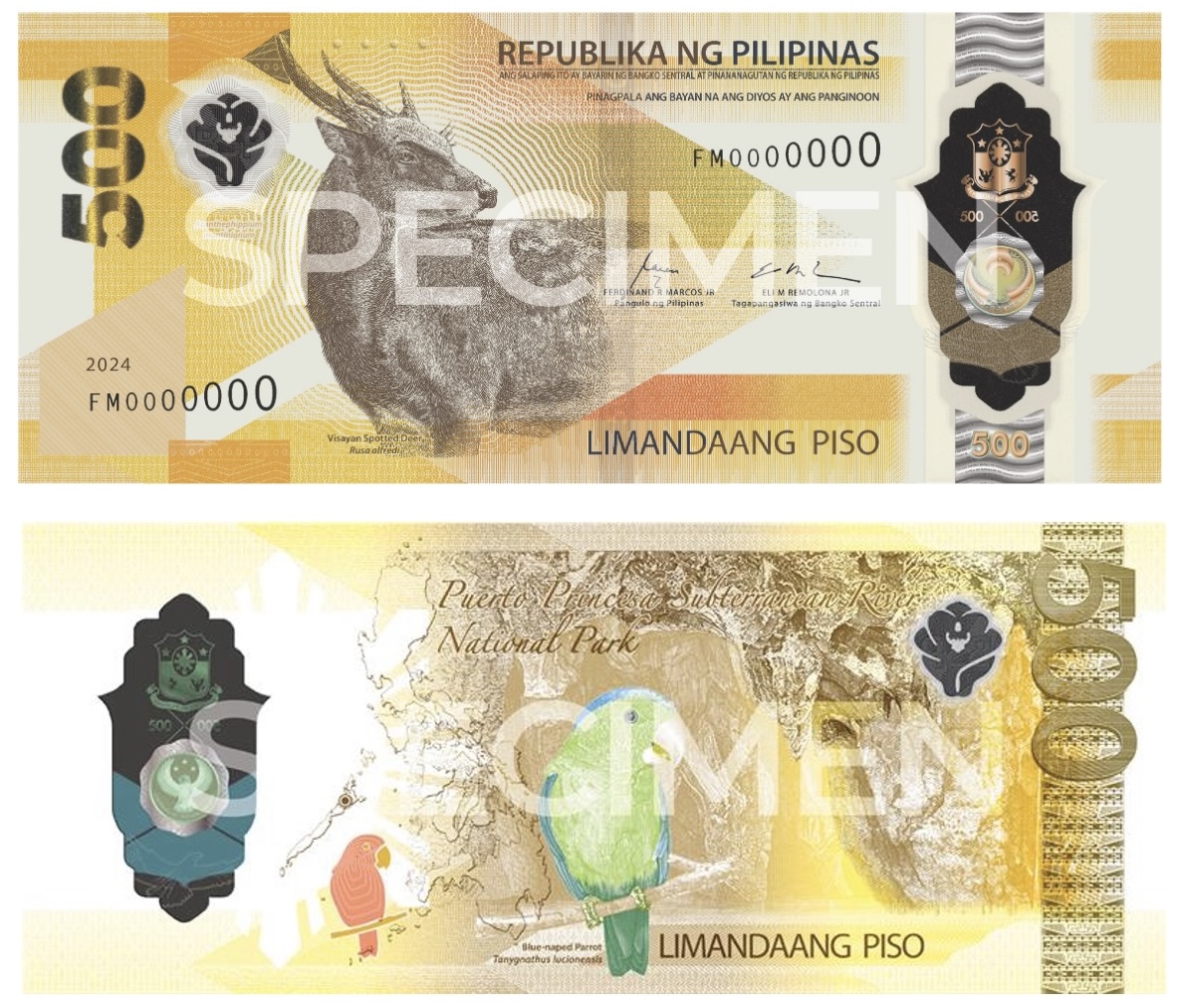
Martin's acanthephippium (Acanthophippium mantinianum) of the Orchid family is currently the only endemic Acanthophippium species. It is found in Luzon, Leyte, Mindoro, Negros, and Panay. This native orchid was named after French orchid horticulturalist M. Georges Mantin.
100-piso: Palawan peacock-pheasant and Ceratocentron fesselii (front); Mayon Volcano, whale shark, and Bicol Region weave design (back)
The Palawan peacock-pheasant (Polyplectron napoleonis) is endemic to the Philippines, particularly in Palawan (thus the name). It is locally known as tandikan in the Palawano, Tagbanwa, and Batak languages. If this black-bodied with blue marks bird looks familiar, that's because it's depicted in the official seal of Puerto Princesa. However, only the male has that distinct black body and blue marks on the wings as well as the blue circles on its grayish tail. The females are mostly brown with a white-colored face.
It's listed by the IUCN as a vulnerable species, a step lower than the endangered assessment. However, its population trend is decreasing with a continuing decline of mature individuals. Mining, quarrying, hunting, and illegal logging in Palawan are the threats to its numbers.
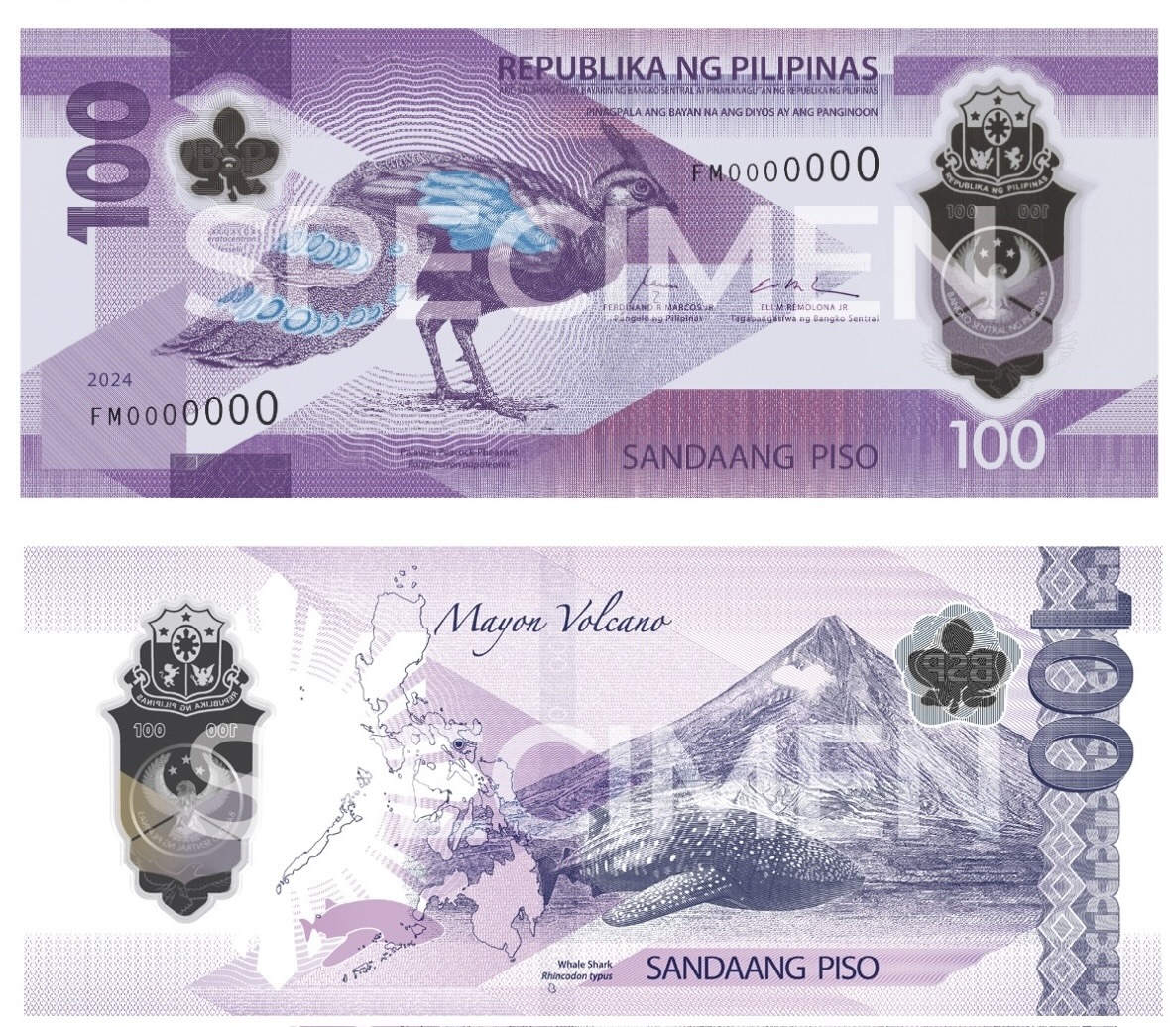
The Ceratocentron fesselii is a critically endangered plant in the family Orchidaceae. It is the only known species in the Ceratocentron genus, making it a monotypic genus in terms of taxonomy. Extremely rare in the wild, this endemic species was first documented in 1989 in northern Nueva Ecija, and can only be found in the high altitudes of Nueva Vizcaya and Nueva Ecija and the Cordilleras.
Over-collection for trade, usually as an ornamental plant, is the number one cause of its decreasing population. Forest degradation in the mountains of Luzon is another factor.
50-piso: Visayan leopard cat and Vidal’s lanutan (front); Taal Lake, native maliputo fish, and Batangas embroidery design (back)
The Visayan leopard cat, which formerly had the scientific name Prionailurus bengalensis ssp. rabori, was listed by the IUCN as a vulnerable species in 2008. It is found in the islands of Panay and Negros, with five housed at the Mariit Wildlife and Conservation Park in Lambunao, Iloilo.
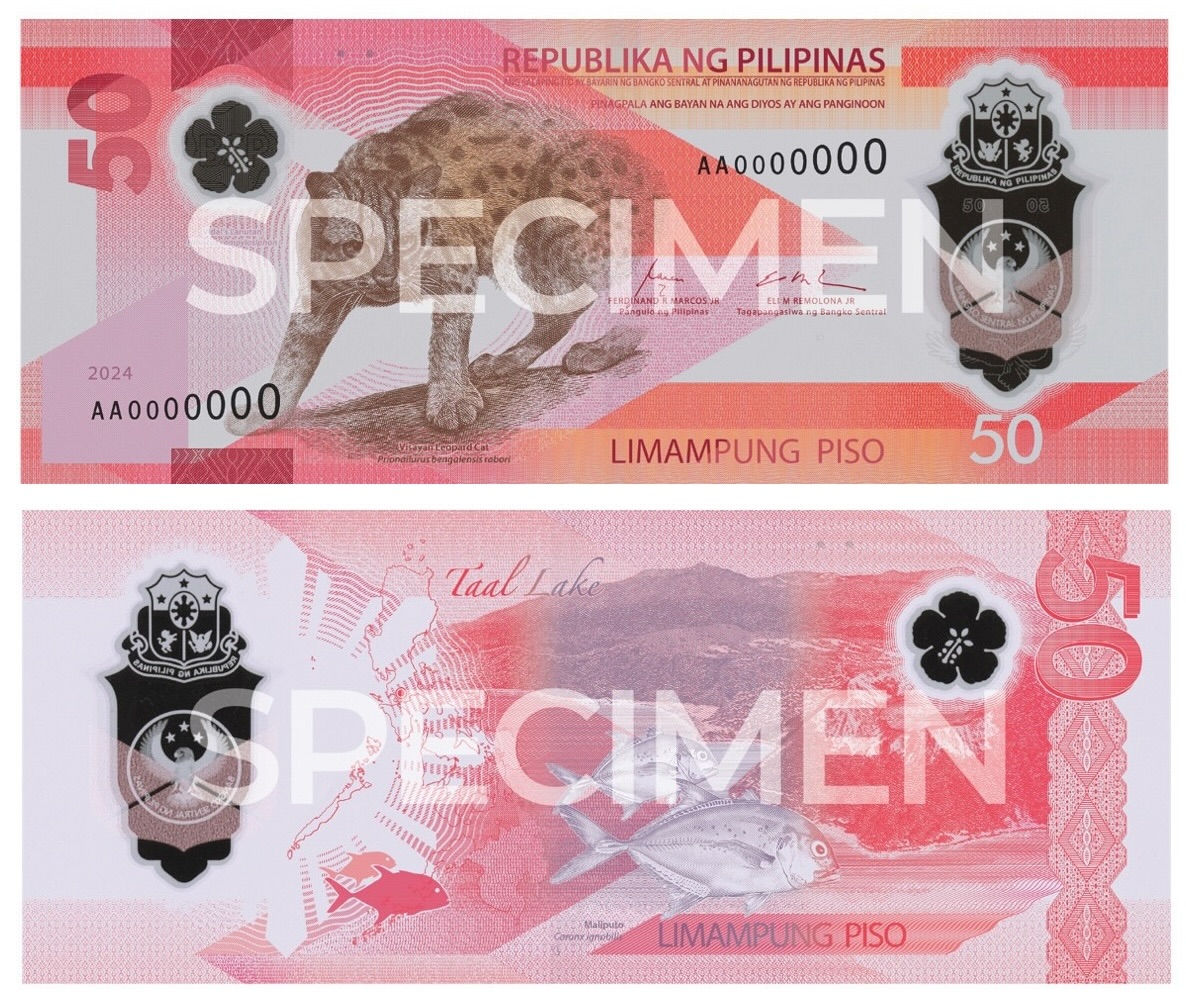
The scientific name of Vidal’s lanutan is Hibiscus campylosiphon, as published in 1858. We're probably more familiar with this genus as the gumamela, known among kids for its bubble-making properties. The Hibiscus campylosiphon, in particular, is a medium-sized tree endemic to Luzon. It has large red-centered flowers that iare white in the morning and turn pink later in the day. Its short trunk is historically used as hardwood for carriage shafts and boat oars.
Plants of the World Online lists Hibiscus campylosiphon as synonymous with the accepted species called Bombycidendron campylosiphon (1904).
3. Philippine Currency Through Time
The first commercial bank of the Philippines, El Banco Español Filipino de Isabel II (now Bank of the Philippine Islands), printed the first Filipino banknotes in 1852. They were originally called Philippine peso fuerte or "strong pesos" with the following denominations: 10, 25, 50, and 200 pesos fuertes. These were text-heavy banknotes, with the initial set (1852-1865) bearing the face of Queen of Spain Isabella II. They were convertible to either gold or silver coins, and were used until 1896.
When the Americans arrived, the Insular Government issued Philippine Silver Certificates bearing the words "By Authority of an Act of the Congress of the United States of America, approved March 2, 1903." El Banco Español Filipino (which dropped Isabel II in its name after the revolution that overthrew the queen) was allowed to print banknotes with Spanish text in 1908. When the bank was renamed Bank of the Philippine Islands in 1912, English-text banknotes were printed. Treasury Certificates replaced Silver Certificates in 1918.
During World War II, two kinds of banknotes circulated in the country: first, the Japanese-issued war notes; second, Guerrilla Notes or Resistance Currencies with low denominations. The war notes had high denominations and no backup reserves, so Filipinos dubbed it "Mickey Mouse Money." Inflation caused the prices of one duck egg to go as high as 75 pesos and a box of matches over 100 pesos.
English Series
In 1949 (years after the war), the Central Bank of the Philippines (now the Bangko Sentral ng Pilipinas) was established and got the rights to issue Philippine pesos. It first printed the English Series, which circulated from 1951 to 1971.
Pilipino Series
Then, the Pilipino Series banknotes were issued and circulated from 1969 to 1974. These featured the faces of Jose Rizal (P1), Andres Bonifacio (P5), Apolinario Mabini (P10), Manuel L. Quezon (P20), Sergio Osmeña (P50), and Manuel Roxas (P100). Coins (1967 to 1998) featured Lapu-Lapu (1 centavo), Melchora Aquino (5c), Francisco Baltazar (10c), Juan Luna (25c), and Marcelo H. del Pilar (50c). The one-peso coin bearing the face of Jose Rizal was first minted in 1972 and withdrawn in 1998.
Ang Bagong Lipunan Series
After former President Ferdinand Marcos declared Martial Law in 1972, the Central bank was decreed to demonetize the existing Pilipino Series banknotes in 1974 and introduce the Ang Bagong Lipunan Series. The remaining banknotes (except the one-peso banknote with Rizal) were sent back to London to have the words "Ang Bagong Lipunan" printed over the watermark area. The one-piso note was replaced with the two-piso note but bearing the same elements. It was printed until 1985.
New Design Series / BSP Series
When Martial Law was lifted in 1981, the Central Bank started conceptualizing an entirely new series. A new five-piso banknote bearing the face of Emilio Aguinaldo was issued on June 12, 1985. The New Design Series (a.k.a. BSP Series) also printed new 10-piso banknotes with Mabini and 20-peso banknotes with Quezon. The 500-piso was supposed to feature the face of the late dictator, but that obviously did not happen, following the new 1987 Constitution. The 50-, 100-, and 500-piso banknotes featured the faces of Osmeña, Roxas, and Benigno Aquino, Jr.
The Ang Bagong Lipunan Series was still legal tender even after the Marcos government was overthrown by the EDSA Revolution in 1986. The banknotes were demonetized in 1993.
In 1991, the BSP issued for the first time a 1000-piso banknote containing the World War II heroes Jose Abad Santos, Josefa Llanes Escoda, and Vicente Lim.
In 1997, Bonifacio's portrait was added beside Mabini on the 10-piso note.
In 2002, the 200-piso banknote was issued showing Gloria Macapagal Arroyo being sworn into office at the EDSA Shrine, while the portrait of his father, Diosdado Macapagal, is on the back.
New Generation Currency Series
The New Design Series (a.k.a. BSP Series) was printed until 2013. It was followed by the New Generation Currency Series. While the former featured historical places and events on their reverse design, such as the Barasoain Church and the Blood Compact of the Katipuneros; the latter showcased the Philippines' natural wonders, flora and fauna, and handicrafts, such as the Banaue Rice Terraces, Batangas embroidery design, and the Philippine tarsier.
The New Generation Currency Series is the set of paper banknotes that we're still using today. This is followed by the First Philippine Polymer Banknote Series.
Frequently Asked Questions About the First Philippine Polymer Banknote Series
The Bangko Sentral ng Pilipinas has issued these FAQs:
Will the paper banknotes be demonetized?
No. The new polymer banknotes shall be circulated alongside the existing paper banknotes. Paper banknotes shall remain legal tender.
Why are there only three new designs (aside from the earlier issued 1000-peso banknote) released by the BSP? Are we going to remove some banknotes?
The polymer series will not include the 200-piso and 20-piso denominations. The 20-Piso New Generation Currency (NGC) banknotes are currently being removed from circulation through natural attrition after the introduction of the 20-Piso NGC coin.
On the other hand, the end of production for 200-piso New Generation Currency (NGC) banknotes was approved in 2021 due to low usage since its launch in 2010. The 200-piso NGC banknote shall remain legal tender until it becomes unfit for recirculation. The BSP assures the continued availability of other banknote denominations.
Should folded polymer or paper banknotes still be accepted?
Yes. Folded banknotes, whether paper or polymer, must be accepted in all payment transactions. All individuals and establishments must accept paper and polymer banknotes.
Will a person get penalized for folding paper and polymer banknotes?
No. A person will not be penalized for folding paper and polymer banknotes and placing them in wallets or pockets. However, the BSP encourages the public to properly handle our banknotes and coins to prolong their lifespan.
Can one iron polymer banknotes?
No. Like paper banknotes, polymer banknotes should not be ironed or exposed to extreme temperatures.
.ph.
Minor edits have been made by the Preview.ph editors.
Hey, Preview readers! Follow us on Facebook, Instagram, YouTube, Tiktok, and Twitter to stay up to speed on all things trendy and creative. We’ll curate the most stylish feed for you!
