
If you’re searching for a place to call home, there are currently 67,600 unsold condominium units across the city—the highest since the pandemic—according to the latest Philippine Property Market Report by Leechiu Property Consultants (LPC).
Of the 67,600 available units in Metro Manila, 32% are ready for occupancy and 68% are in the pre-selling stage. Quezon City leads with 18,500 available units, while Ortigas follows with 13,500.
For buyers, this means there’s room to negotiate. With so many units available, developers might offer better payment terms, especially for pre-selling properties, which make up a big chunk of the current stock. Plus, the Bangko Sentral ng Pilipinas (BSP) has recently lowered the interest rates to 6% effective October 17, so getting a home loan could become a little easier.
It's a bit more challenging for those who are gunning for the usual commercial business districts like Makati City or Bonifacio Global City (BGC), where there is less inventory at 3,400 units in Makati and 1,300 in BGC. Beggars can't always be choosers, but they can try.
Here are the LPC's numbers of unsold units per city, including both current and pipeline projects:
- Quezon City – 18,500
- Ortigas – 13,500
- Bay Area in Pasay City – 10,500
- Manila – 8,500
- Caloocan City – 6,100
- Alabang – 5,800
- Makati City – 3,400
- Taguig/Bonifacio Global City – 1,300
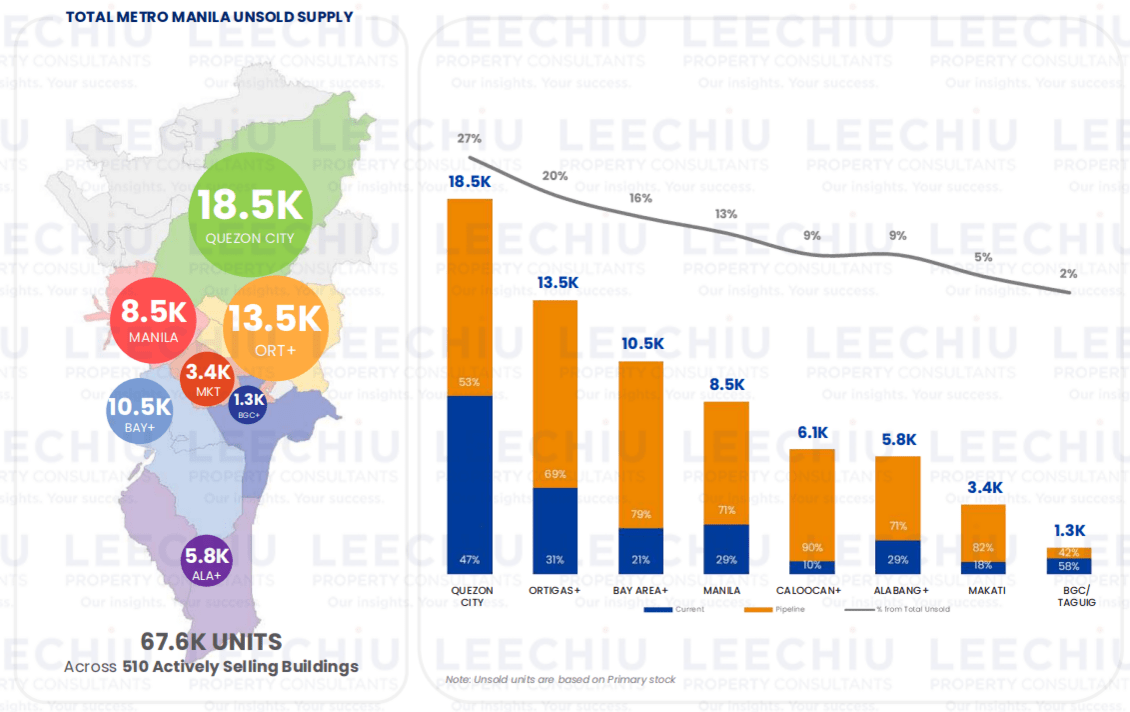
A Look Into Housing in Metro Manila
Developers have been hitting the brakes on launching new projects, which dropped by 39% from July to September 2024. Despite fewer projects, demand has stayed fairly consistent, with nearly 7,000 units sold for the third quarter in a row as per LPC.
“This decline can be attributed to high interest rates, geopolitical and global economic uncertainties, and the shift in demand of local buyers toward nearby provinces,” LPC noted in the report. In recent years, a significant trend has emerged among the middle and upper-middle classes: the pursuit of second homes outside Metro Manila. Santos Knight Frank identifies a surge in interest in Tagaytay, Batangas, Pampanga, Bulacan, Cavite, and Laguna.
Plus, oversupply doesn’t always translate to affordability.
The Philippine Institute for Development Studies found that most Filipinos can't afford houses near their workplaces, with low-income families particularly struggling with the standard rule of using 30% of their income on housing costs.
In addition, the UN-Habitat Philippines reported a housing backlog of 6.5 million units in 2022, with this figure expected to balloon to 22 million units in 2040.
*This story originally appeared on Spot.ph. Minor edits have been made by the Preview.ph editors.
Hey, Preview readers! Follow us on Facebook, Instagram, YouTube, Tiktok, and Twitter to stay up to speed on all things trendy and creative. We’ll curate the most stylish feed for you!
